

By Wes Chun, Ph.D., Chief Science Officer Emeritus
Introduction
Sulfur is in Group 16 of the Periodic Table of Elements (the Oxygen Group), and includes selenium, tellurium, polonium, and artificially produced livermorium. Sulfur is the ninth most common element on Earth comprising 0.05% of the Earth’s crust. China is the world’s largest sulfur producer, but sulfur is also found in huge, almost pure deposits along the Gulf Coast of the United States, Poland, and Sicily. It is also found in the form of sulfates in minerals and ores such as gypsum (calcium sulfate, CaSO4.2H2O), barite (barium sulfate, BaSO4), and Epsom salts (magnesium sulfate, MgSO4.7H2O). Seawater contains about 0.09% sulfur in the form of sulfate. Both calcium sulfate and magnesium sulfate are important fertilizers for plants.
Pure sulfur is a pale yellow, crystalline, nonmetallic solid that is odorless, tasteless, combustible, and insoluble in water. It can react with all metals (except gold and platinum) to form metal sulfides. Several tons of sulfur are annually produced, mostly for manufacturing sulfuric acid.
Sulfuric acid is the parent molecule of all sulfate compounds, many of which are naturally-occurring. Some examples are alabaster which is used for carving and making plaster, gypsum which is widely used as a fertilizer, and selenite a crystalline form of gypsum said to promote peace and calm, mental clarity, and well-being. Copper sulfate is also naturally-occurring and is used as an agricultural insecticide, and to kill algae in water supplies. Alums are double sulfates of aluminum or another metal such as potassium, chromium, or iron. A common alum is potassium aluminum sulfate KAl(SO4)2.12H2O. It is very useful for water purification since it forms a goopy precipitate (coagulant, flocculant) of aluminum hydroxide. This flocculant carries along all sorts of particles and phosphorus which can then be removed by filtration or by allowing it to settle.

Sulfuric acid is also the parent molecule of all sulfides, a group of compounds that contain sulfur and a metal. These include metal ores such as iron pyrites (iron sulfide, FeS2), galena (lead sulfide, PbS), cinnabar (mercuric sulfide, HgS), stibnite (antimony sulfide, Sb2S3), zinc blende (zinc sulfide, ZnS), and sulfides of copper and silver. Some sulfides are used in leather tanning, as pesticides, and in hair removal creams. Hydrogen sulfide at low concentrations has a foul-smelling odor like rotten eggs but has a sickening sweet odor at higher concentrations. Mercaptans are organo-sulfur compounds containing carbon, hydrogen, and sulfur, that are notable since they are detectable by the human nose. Most mercaptans have the aroma of rotting cabbage or garlic. Others smell like stinky socks or smelly feet. In nature, mercaptans are found in gas, oil, and food, and animal and human waste products. Mercaptans are added to natural gas as a warning agent. Unfortunately, the pleasant-smelling grapefruit mercaptan or other mercaptan rich citrus oils are only used in the perfume or liquor industry and not as warning agents.
Sulfur has direct use as a fungicide and insecticide, in the vulcanization of natural rubber, and as a component in the manufacture of matches, fireworks, and gunpowder. Along with saltpeter, coal, bamboo, diamonds and some rope, sulfur allowed Captain Kirk of the Starship Enterprise to demonstrate to the Metrons that “We’re a most promising species.”
Sulfur is an essential element for all life and is almost always in the form of organosulfur compounds or metal sulfides. Two proteinogenic amino acids (cysteine and methionine), several other non-coded amino acids (cystine, taurine, etc.), and two vitamins (biotin and thiamine) are organosulfur compounds that are crucial for life. Many cofactors also contain sulfur such as glutathione and iron–sulfur proteins. Disulfides have sulfur bridges (S–S bonds) that confer mechanical strength and insolubility to the protein keratin that is found in outer skin, hair, and bird feathers. Sulfur is one of the core chemical elements needed for biochemical functioning and is an elemental macronutrient for all living organisms.
After nitrogen, phosphorus and potassium, sulfur is the fourth most needed fertilizer nutrient by plants. Higher yielding crops take up and remove sulfur from the soil increasing the need for sulfur fertilization. This has become more apparent since there is less atmospheric sulfur due to the recent decrease in industrial and transportation emissions.
Sulfur in Plants
Sulfur is an essential nutrient for adequate growth and development of plants. It is a structural component of protein disulfide bonds, amino acids, vitamins, and cofactors. Total sulfur content in vegetative parts of crops range between 0.1 and 2% of the dry weight. Sulfur and sulfur-containing compounds act as signaling molecules in stress management and other metabolic processes, and as a mediator molecule in signaling networks in plants. Plants uptake sulfur as water-soluble sulfates (SO42-) using their own dedicated sulfate transporters and transporters of symbiotically associated bacteria and fungi. The uptake and assimilation of sulfur and nitrogen are interrelated and dependent on each other. With adequate levels of sulfur available, the organic N:S ratio is around 20:1. Approximately 70% of the sulfur in plants is present in cysteine and methionine residues of proteins. The remaining sulfur is located in a variety of organic compounds such as thiols, sulfolipids, and secondary compounds such as alliins and glucosinolates. Thus, sulfur compounds are of great significance in proper plant function, important for food quality, and the production of phytopharmaceuticals. A few reported roles for sulfur include: improving starch content of tubers; formation of chlorophyll; increase crop yield and quality; increase oil content of seeds; increase uptake of nitrogen, phosphorus, and potassium; protein synthesis (S-containing amino acids include; cysteine, cystine, methionine); stress reduction; enzyme activation; and biological nitrogen fixation. Cysteine and methionine play significant roles in the structure, conformation and function of proteins and enzymes in vegetative plant tissues. High levels of these amino acids are also found in seed storage proteins. Cysteine is very important for the ability of its side chain to form disulfide bridges. For example, it is very important for the baking quality of wheat as cysteine contributes to elasticity and allows the bread to rise and maintain shape during baking.
The amount of sulfur required by plants differs between plant species and during various plant growth stages. Sulfur is actively taken up as sulfate by root cells, loaded into the xylem, and transported to the shoot. There, chloroplasts reduce sulfate to sulfide then cysteine which is then incorporated into organic sulfur compounds. Plants are also able to absorb sulfur gas through the foliage. Atmospheric sulfur dioxide and hydrogen sulfide levels greater than 0.05 uL/L air are significant contributors of sulfur for plants. Due to the Clean Air Acts in the 1980’s, the world’s effort to reduce pollution has increased the annual sulfur fertilizer deficit.
Sulfur in Soils
There are several sources of sulfur in the soil. Organic matter contains around 95% of the total sulfur in soil. However, organic sulfur is not available to plants until the organic matter is broken down and mineralized SO42- is released. Other forms of sulfur in soil also require breakdown or mineralization to become available to the plant. In industrial areas or where coal and oil fuel-burning occur, there is usually higher levels of sulfur in the air. This sulfur, in the form of sulfur dioxide (SO2), is dissolved in rainwater and deposited in the soil. However, pollution controls have reduced the amount of atmospheric sulfur and growers near industrialized areas will find that sulfur supplementation usually results in beneficial crop gains. Some pesticides contain sulfur but the amount is generally small and overall contribution to plant growth not significant.
Sulfur Deficiency Symptoms
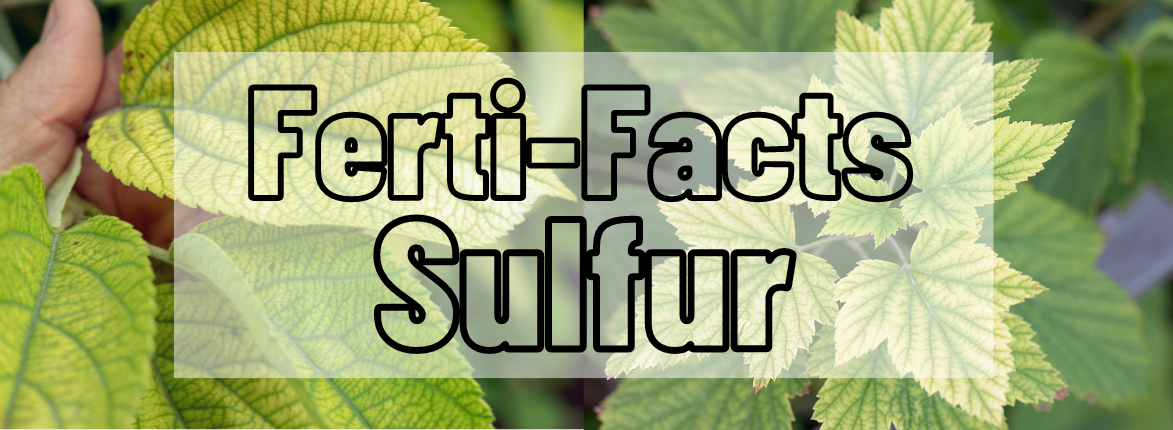
Sulfur deficiency results in poor plant quality and lower yields. A mild deficiency may not impact yields but crops may be lower in quality. Once sulfur is assimilated into organic compounds in the plant, it is considered “fixed” and cannot be mobilized to other tissues in the plant. Hence sulfur deficiency symptoms are first observed on new leaves, and young tissues of leaves, stocks, and flower buds. The most common deficiency symptom is chlorosis that rarely becomes necrotic as it does with nitrogen and magnesium deficiencies. Other symptoms may include stunting, spindly plants, less tillering in small grains, low protein content in seed and vegetative parts, fewer leaves, and high susceptibility to stress (weather, pest, and pathogens). Symptoms can vary with different plants and may be difficult to diagnose with visual symptoms alone. Deficiency symptoms are easier to diagnose on canola, followed by potato, sugar beets, beans, peas, cereals, and maize. Below is a table of sulfur deficiency symptoms of a few economically important plants.
Sulfur deficiency symptoms in economically important plants (Narayan, O. P. et. al. 2022. Sulfur nutrition and its role in plant growth and development. Plant Signaling and Behavior. doi.org/10.1080/15592324.2022.2030082
| Plants | Symptoms |
| Banana | Young leaves show chlorosis. Severe sulfur deficient conditions lead to chlorosis in between the veins. Retracted growth and small fruits are produced. |
| Chickpea | Plants appear erect, premature drying, and withering of young leaves. |
| Coffee | Young leaves show yellow color, mature leaves show chlorosis of mature, small leaves size. Interveinal tissue looks like a mottled appearance. |
| Cotton | Persistent yellowing of new leaves and reddening of the petiole. |
| Groundnut | Small Plant height. A “V” shaped petiole appearance. New leaves, the area around the main vein may be pale. Seed maturity delayed. |
| Maize | The initial stage, yellowing between the veins in younger leaves. Later, reddening at the base of the stem and along the leaf margins. |
| Mung bean | Stunted plants, reduced branching and flowering, and pods have shrunken seeds. |
| Pea | Chlorosis in young leaves. Flowering and yield are reduced. |
| Potato | Evident inward curling of youngest leaves, substantial yellowing of the stems, overall yellowing of the plants. |
| Rice | Yellowish leaf sheath and leaf blade. Reduced plant height and number of tillers. Fewer panicles, shorter and fewer grains. |
| Rubber | The entire leaf surface turns a yellowish-green color, reduced in size, with typical brown necrotic spots at the tips of the leaves. |
| Sugarcane | Younger leaves become yellowish-green colors. Older leaves show a faint purplish tinge. Stems are thinner and taper toward the tip. |
| Sunflower | Leaves and flowers become pale. Plants are smaller with shorter internodes. Reduced number and size of leaves. |
| Tea | Sulfur deficient bushes turn yellow, reduce in leaf size, short internodes, the entire plant appears shrunken. Leaves curl up and their edges and tips turn brown. |
| Tobacco | Young leaves are uniformly pale-yellow green. Leaves are smaller and internodes are shorter. |
| Tomato |
Small plant height and lighter green. Yellowing in various plant parts. In the severe deficiency, petioles and stems show a clear reddening. |
| Wheat | Yellowing of the plant, more prominent between the veins. |
Sulfur deficiencies can also occur in soils with low amounts of organic matter, and seasonally in high organic content soils under lower temperatures or water stress where decreased microbial activity results in less mineralized sulfur. Plants grown in sandy soils, and soils at higher elevations also can suffer from a sulfur deficiency.
Fertilizing with Sulfur
Sulfur can be added to crops as elemental sulfur, gypsum, chemical fertilizers, farmyard manure, compost, and organic matter. Elemental sulfur requires microbial activity to mineralize sulfur into plant-available sulfate. This process can take weeks to years depending on soil temperature, moisture, pH, and aeration. Mineralization can be aided by using smaller sized particles of sulfur. Gypsum (calcium sulfate) also requires time to mineralize into plant available forms. Sulfur containing fertilizer such as ammonium sulfate, ammonium thiosulfate, potassium magnesium sulfate, and potassium sulfate, immediately release plant-available sulfate.
Higher sulfur applications may increase availability of other micronutrients such as copper, manganese, cobalt, nickel, and cadmium. Sulfur can also acidify the soil which may decrease availability of arsenic, boron, selenium, and molybdenum to the plant. Excessive sulfur fertilization in intensively-grown brassica crops in coarse soils may induce boron or molybdenum deficiency.
Crop Responses to Sulfur
Early identification of sulfur deficiency is necessary to prevent field losses. Sulfur fertilization frequently results in improved crop yield and quality. This is especially important for crops with a high sulfur requirement such as oil seeds (soybean and canola) and forage crops.
Sulfur Toxicity Symptoms
Sulfur toxicity in plants is extremely rare. The only exception is in hydroponics where high sulfur concentrations can increase salt levels. This results in plants that appear stunted and dark in color. Leaves may be smaller and plants may have yellow or scorched tips (these two symptoms are also symptoms of a sulfur deficiency). A general rule of thumb is not to worry about sulfur toxicity. If you have a hydroponic system, you can easily check for salt levels and flush the system with pure water if needed.
Summary
Sulfur nutrition is essential for growth and development of plants. It plays a number of vital roles in the plant and plant responses such as induced resistance. Sulfur is present in the form of organically bound sulfur, mineral bound sulfur, and free sulfate which is the form available to plants. Sulfur deficiencies generally manifest as retarded growth and yield. Plants are able to take up sulfur from soil over a wide concentration range via low and high affinity transporters. The major advantage is that sulfur can come from a variety of sources and used without too much concern for toxicity. Sulfur can come from fertilizers, pesticides, atmosphere, and irrigation water. In the past vehicle and industry sulfur dioxide emissions contributed a significant amount of sulfur to the sulfur pool. However, industrial pollution control has decreased that amount to where sulfur deficiencies are more common. Sulfur deficiencies can be difficult to discern so soil and plant analyses are suggested. Be aware that nitrogen and sulfur are closely related and that supplementation should try to maintain the optimal N:S ratio of 20:1.
Without sulfur, we would suffer. Ancient cave painters would not have sulfur for the color yellow. There would be no Fool’s Gold (pyrite, FeS2). Crystal practitioners would have to find another crystal instead of selenite (calcium sulfate, CaSO4.2H2O). Captain Kirk would have been killed by the Gorn captain. Since atmospheric sulfur no longer is a significant contributor of sulfur to plants, sulfur fertilization is now more important for producing quality crops.